
European Network of Ombudsmen marks 30 years of cooperation
Published October 23, 2026
European Network of Ombudsmen marks 30 years of cooperation
Published October 23, 2026
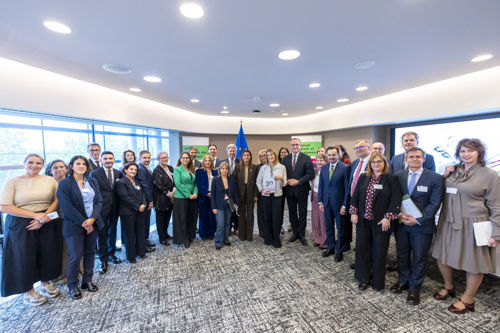
The European Network of Ombudsmen (ENO) is marking its 30th anniversary in 2026, celebrating three decades of cooperation between Ombudsman institutions across Europe in promoting good administration, protecting rights and helping citizens navigate the interaction between national and European administrations.
To commemorate the anniversary, European Ombudswoman Teresa Anjinho presented a special 30th Anniversary Report to the President of the European Parliament, Roberta Metsola, during a ceremony at the European Parliament in Strasbourg.
The report was prepared by the European Ombudsman together with members of the Network and looks back at the development of ENO, the contribution of national and regional Ombudsman institutions to the implementation of European Union law, and the practical difference that cooperation between Ombudsmen has made to persons across Europe.
ENO was established in 1996 by the first European Ombudsman, Jacob Söderman, with the objective of making citizens’ rights under EU law a practical reality at European, national and regional level. Today, the Network brings together more than 60 Ombudsman offices within the European Union, alongside Ombudsman institutions from Norway, Iceland and countries applying for EU membership.
The anniversary report highlights how EU law, including the Charter of Fundamental Rights of the European Union, has increasingly formed part of the work of Ombudsman institutions when addressing maladministration, protecting rights and recommending improvements to public administration. It also documents the Network’s mechanisms for cooperation, including the exchange of information, queries concerning EU law, parallel investigations and regular conferences and meetings.
Malta’s contribution to the Network
The Office of the Parliamentary Ombudsman in Malta has been an active participant in the European Network of Ombudsmen for many years, contributing to exchanges of experience, discussions on EU law and wider cooperation between independent oversight institutions.
In his contribution to the anniversary publication, Parliamentary Ombudsman Judge Joseph Zammit McKeon refers to the strength of cooperation within ENO and Malta’s active contribution to the Network. He highlights ENO as a practical platform through which Ombudsman institutions can share expertise and respond to challenges arising from EU law and public administration, while stressing that continued active participation by its members remains essential for the Network to deliver effectively for people across Europe.
The publication also recognises the service of Malta’s Parliamentary Ombudsmen over the years among the Ombudsmen who have formed part of this European community of independent institutions.
Maltese case featured in the anniversary report
The report includes a case investigated by the Parliamentary Ombudsman in Malta as an example of how national Ombudsman institutions can use EU law to protect persons from maladministration.
Case OMB-25-6334 concerned a Greek national who was registered as a Professional Engineer in Spain and sought recognition of his professional qualification as a *Perit Inġinier Ċivili* in Malta under Directive 2005/36/EC on the recognition of professional qualifications.
The complainant experienced prolonged delays, unclear instructions and changing requirements from the Periti Warranting Board. Among other issues, he was initially required to establish residence in Malta and obtain a Maltese identity document in order to access the application system.
Following his investigation, the Ombudsman concluded that the Board had breached Directive 2005/36/EC and the Maltese legislation transposing it. The requirements imposed were found to be disproportionate, the criteria relating to establishment had been incorrectly interpreted, and the applicable statutory time limits had not been respected. The Ombudsman concluded that this amounted to maladministration and constituted an unlawful restriction on the complainant’s access to the profession.
When the Periti Warranting Board did not react to the Final Opinion, the Ombudsman referred the report to the Prime Minister. Following no reply, the Final Opinion was subsequently referred to the House of Representatives. In March 2026, the Office of the Prime Minister informed the Ombudsman that the recommendations were being accepted and would be implemented by June 2026.
The case is presented in the ENO report among examples from across Europe demonstrating how Ombudsman interventions can help ensure that rights arising from EU law are translated into practical outcomes at national level.
Looking ahead: technology and artificial intelligence
The anniversary report does not only look back at the Network’s achievements. It also addresses emerging challenges facing Ombudsman institutions, particularly the growing use of technology and artificial intelligence.
A significant part of the publication is the new Code of Good Practice for Ombuds Institutions in the Use of Technological Systems, developed as part of the 30th anniversary initiative. The Code was drafted with the involvement of the Czech, Estonian and Finnish Ombudsman institutions and contributions from ENO members.
The Code establishes guiding principles for the internal use of artificial intelligence and other technological systems by Ombudsman institutions. Its purpose is to ensure that technology supports good administration and fundamental rights while remaining transparent, impartial and subject to meaningful human oversight.
Among the principles addressed are non-discrimination, accessibility, transparency and accountability, human oversight, data protection and privacy. The Code emphasises that technological systems should assist Ombudsman institutions without replacing human judgement, careful listening and meaningful interaction with persons seeking their assistance.
It also provides that technology should not create barriers to accessing an Ombudsman and that people should remain able to interact with a member of staff. Responsibility for decisions and findings must continue to rest with identifiable officials, even where technological systems contribute to the handling of a case.
Thirty years of practical cooperation
Speaking at the presentation of the report, European Ombudswoman Teresa Anjinho emphasised that the value of ENO lies in practical cooperation between institutions and in their capacity to help people whose problems often cross administrative or national boundaries.
The anniversary report reflects how the role of Ombudsman institutions has developed over the past three decades, from resolving individual complaints to addressing systemic issues and taking on new monitoring responsibilities deriving from EU legislation.
As ENO enters its fourth decade, the Network continues to provide a framework through which independent Ombudsman institutions can share expertise, cooperate across borders and strengthen their collective contribution to good administration, fundamental rights and public trust.
For the Office of the Parliamentary Ombudsman in Malta, continued participation in the Network remains an important part of its international engagement and its commitment to learning from, and contributing to, the wider European Ombudsman community.

