
Justice without force: The persuasive authority of the Ombudsman
Published April 07, 2026
Justice without force: The persuasive authority of the Ombudsman
Published April 07, 2026
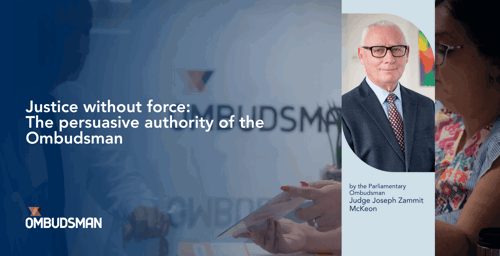
By the Parliamentary Ombudsman, Judge Joseph Zammit McKoen
Introduction
There are instances where an Ombudsman has doubts as to whether the actions of the institution are being effective enough, or are being sidelined for anything but good reasons, or finds in the way unyielding and stubborn attitudes. Doubts of this nature are the result of reflection, not a weakness. On the one hand they encourage moral serenity and on the other highlight an awareness of challenges ahead.
The question for an Ombudsman to ask is:
in times of distrust and persistent conflict, do bodies legally entrusted with the oversight of public services really have a modest influence on the people responsible for those services or are their tools structured in too gentle a manner to enable the institution to carry out its mandate fully and well?
I shall be answering this legitimate question in clear terms and with an open mind.
“Soft law”
The Office of the Ombudsman has been described as a creature of “soft law” because it does not impose executive orders, but investigates, recommends and persuades. Nonetheless the choice of the adjective “soft” is not misplaced. The Ombudsman speaks the truth to the public administration, without the need to resort to the sharp instruments of executive enforcement.
In troubled times, when loud and uncompromising voices tend to dominate public statements and debate, the Ombudsman could appear to be ineffectual. And yet, experience has repeatedly shown that institutions like the Ombudsman, that are grounded in fairness, transparency and reasoned dialogue, are never weak, but have steadily gathered relevance and standing.
Dignity
The foundational role of the Ombudsman is the pursuit of justice for the person in its relations with the administrative functions of the State. That includes ensuring that the public administration is not merely efficient but fair, not merely lawful but respects the dignity of the person.
Every complaint is not just a file to be processed. It is a human story, often one of frustration, vulnerability and exclusion. When matters are resolved and solutions are found following investigations, proper public administration and trust are restored. Without these essential components, people are tempted to view rules with suspicion and public institutions as adversaries with the risk that people retreat into diffidence or worse anger.
Bridge
By providing accessible and independent oversight, the Ombudsman acts as a bridge between persons and the State. That effort might not dominate the headlines, but it quietly prevents fractures from becoming chasms. And the Ombudsman has an obligation by the use of its persuasive powers to contest all who might have an interest in demolishing that bridge carefully built with courage, patience and determination.
Defence
The rule of law is not secured solely in courtrooms. It is upheld in the daily conduct of public officials, in the fairness of procedures, and in the clarity of reasons given for decisions.
When the Ombudsman identifies maladministration, recommends corrective action, or calls attention to systemic shortcomings, there is a strong ripple effect: public bodies have to refine their processes, public officials have to become more respectful where the rights of people are concerned, and policies have to be adjusted to better reflect legal and ethical standards. This is what disciplined and tangible improvement is all about.
When persons experience what it means to be unheard, dismissed, or treated unjustly, that can give rise to resentment. Institutions like the Ombudsman, that can offer fair hearing and impartial review, provide an alternative to despair, and send out the message that disputes can be resolved within impartial and constitutional institutions that need not necessarily be the courtrooms.
Attention
Every complaint deserves attention. Every person has the right to be treated fairly. This moral and policy statement, put in practice daily, strengthens a culture that human dignity is non-negotiable.
When recommendations are ignored, including (but not only) because of political pressures that may be subtle but persistent, doubts on effectiveness can arise. But any doubt should not lead to submission. Instead, it should reinforce the sense of purpose.
Quality
The influence of the Ombudsman lies in its credibility, on the quality of its reasoning, on the fairness of its procedures, and the consistency of its principles. When findings are meticulously grounded, when the tone in investigative reports is measured and constructive, and when commitment to impartiality is unwavering, then moral authority becomes all the stronger and that authority becomes extremely difficult to put aside.
Collaboration
Ombudsmen across jurisdictions share best practices, comparative insights, and collective standards. Networks of oversight institutions contribute to a broader culture of accountability that goes far beyond national boundaries. While each Office may appear modest in isolation, when together Ombudsmen form a global community dedicated to good governance and human rights, because they are offices that do not exist simply for self-preservation but first and foremost for an upright service to the public.
Challenges
The challenges of our trouble times worldwide require patience, independence, integrity, and courage : the patience to examine complex cases to the extent they deserve ; the independence to resist external influence, be it rightful or otherwise ; the integrity to insist on the adherence of principles (including the principles of good administration of worldwide application) even when they are inconvenient ; and the courage to express where necessary even publicly uncomfortable truths.
Resilience
The Ombudsman has shown to all that disagreement in the administration of public affairs can be addressed through structured inquiry rather than confrontation. The institution has been a proven instrument of meaningful accountability because it firmly believes that governance is not a contest of dominance, but a shared endeavour grounded in the respect of rights.
This resilient approach in favour of accountability might not be so much visible for all, but it is an enduring influence. For the persons whose grievance has been resolved, the effect is deep; for the public body that re-addresses its procedures, the benefits extend to future interactions; but for the broader society, each instance of improved administration upholds the rule of law.
Democracy is sustained by countless acts of fairness, transparency, and accountability. The Ombudsman is committed to the principle that power must answer to reason, that authority must be exercised with fairness, and that every person has the right to seek redress without fear.
Conclusion
The powers of the Ombudsman have been described as “soft”. But all the principles that the Ombudsman defends are not. They are firm, steadfast and essential. As long as there are persons who seek justice in their dealings with the State in a non-judicial framework, then the role and mandate of the Ombudsman will not only remain relevant but also indispensable.
Published on newsbook.com.mt on 7th April 2026
