
Second day of Bilbao-Gernika seminar focuses on Ombudsman independence and democratic resilience
Published November 19, 2026
Second day of Bilbao-Gernika seminar focuses on Ombudsman independence and democratic resilience
Published November 19, 2026
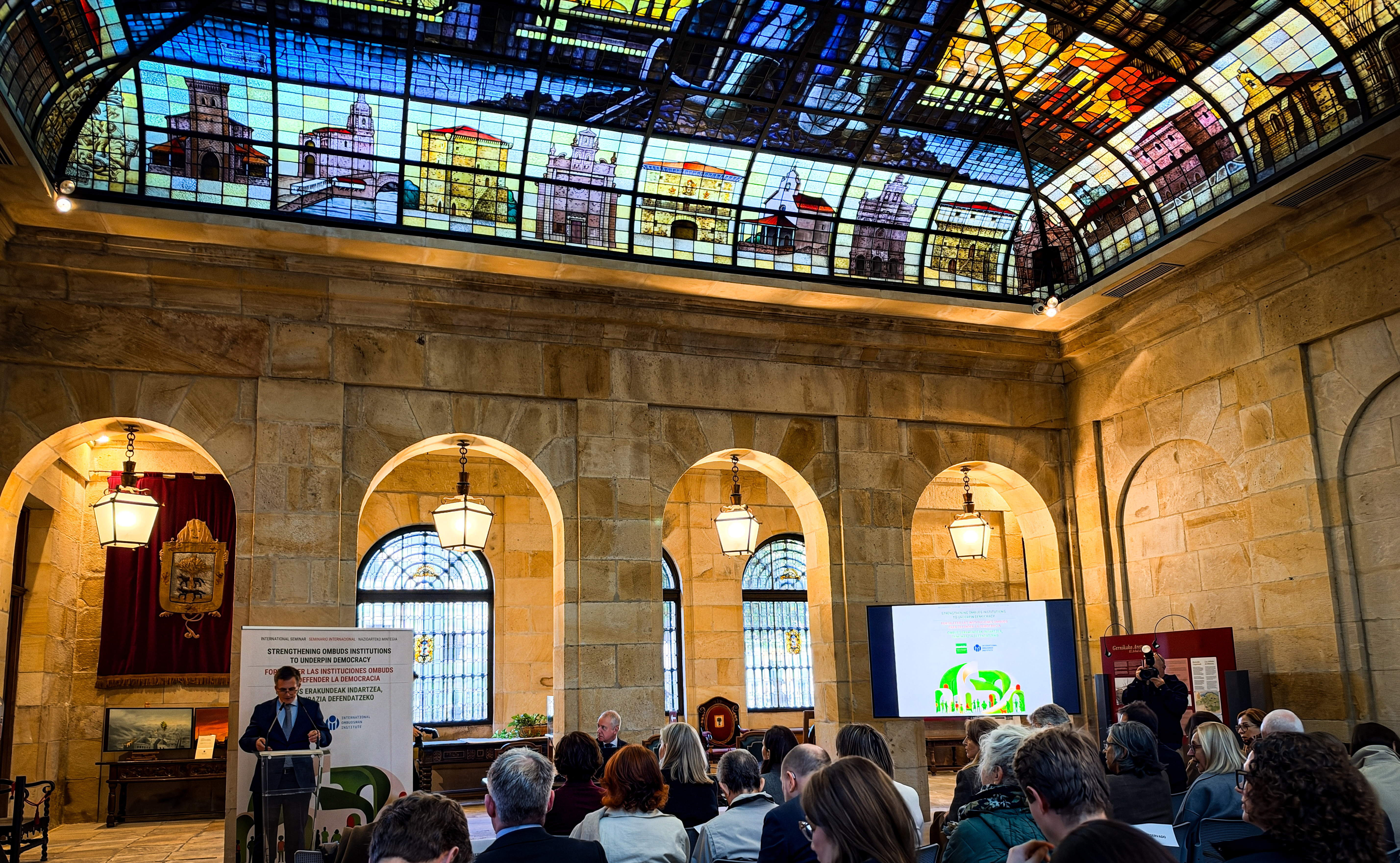
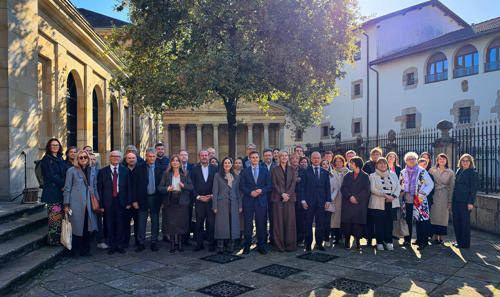
The Parliamentary Ombudsman, Judge Joseph Zammit McKeon, continued his participation in the international seminar “Strengthening Ombuds Institutions to Underpin Democracy”, organised by the Ararteko-Ombudsman of the Basque Country in collaboration with the International Ombudsman Institute.
The second day moved from Bilbao to the historic Assembly House of Bizkaia in Gernika, where discussions focused on the independence of Ombudsman institutions, the rule of law and their role in strengthening democracy.
The setting carried particular significance. The Assembly House stands beside the Tree of Gernika, one of the principal symbols of Basque liberties, self-government and institutional continuity. Historically, representatives gathered beneath the tree and political authorities were required to respect established laws and traditions.
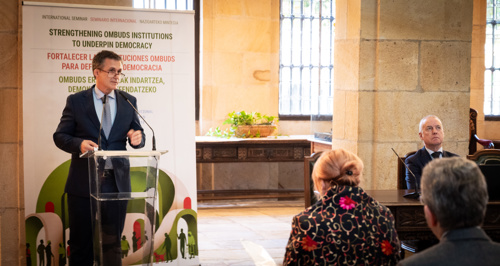
Opening the proceedings, Mikel Mancisidor, Ararteko-Ombudsman of the Basque Country, reflected on the wider crisis facing democracy and the responsibility of Ombudsman institutions to use their mandates and powers to protect and promote democratic values.
He invited participants to consider what Ombudsman institutions should be doing in this changing environment and how they can perform their role more effectively.
Referring to the Tree of Gernika, he highlighted its relevance to the discussion taking place. Its history reflects the principle that political authority itself is subject to rules and limitations, a principle which remains central to democratic governance and the work of independent oversight institutions.
Democracy requires institutions that earn public trust
The special opening presentation was delivered by Iñigo Urkullu, former President of the Basque Country and President of the eAtlantic Foundation, on “Europe as Beacon of Democracy in Times of Uncertainty”.
Mr Urkullu reflected on the scale and speed of change experienced by recent generations and raised a fundamental question about which institutions are capable of protecting democracy when democratic systems come under pressure.
He identified the gradual degradation of liberal democratic systems, including through populist politics, as a significant challenge.
He stressed that democracy cannot survive through rules and institutions alone. It also depends on public trust.
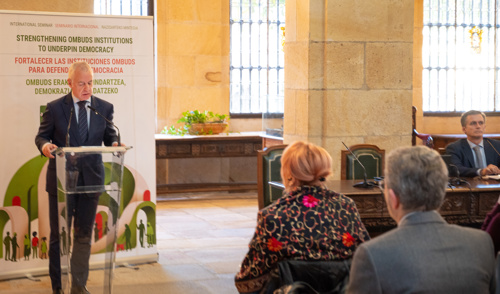
Within this context, he highlighted the role of Ombudsman institutions. The quality of a democracy, he argued, can also be measured by the strength and independence of the institutions established to protect human rights, scrutinise public authority and provide accessible means of redress to citizens.
Such institutions must remain accessible and focused on serving people if they are to retain public confidence and contribute effectively to democratic resilience.
The work of the eAtlantic Foundation
Mr Urkullu also referred to the work of the eAtlantic Foundation, which he chairs.
The Foundation brings together public and private actors with the aim of strengthening cooperation across Europe’s Atlantic regions, promoting sustainable development and improving their contribution to the European project.
Its work also extends to areas such as European competitiveness, participatory and multilevel governance, democratic quality and dialogue between Europe and the Global South.
Independence as a cornerstone of the Ombudsman institution
The day continued with a session entitled “Ombuds Independence: Cornerstone of the Defence of the Rule of Law and Democracy”.
Rafael Bustos, substitute member for Spain in the Venice Commission, addressed the application of the Venice Principles at state and sub-state levels. Reinier van Zutphen, National Ombudsman of the Netherlands and President of IOI Europe, discussed the accreditation of Ombudsman institutions in light of the Venice Principles, while Luísa Neto, Ombudsperson of Portugal, examined the challenges and opportunities arising from the relationship between the Venice Principles and the Paris Principles.
The discussion underlined that institutional independence requires more than formal recognition. Ombudsman institutions need adequate legal safeguards, resources and operational autonomy if they are to scrutinise public administration effectively and maintain public confidence.
The final panel considered the broader role of Ombudsman institutions in strengthening democracy.
Esther Giménez-Salinas, Ombudswoman of Catalunya, addressed the need for a person-centred administration responsive to social needs. Christian Britten Lundblad, Parliamentary Ombudsman of Denmark, discussed fragmented rights and fragmented public institutions, while former Romanian Ombudsperson Renate Weber focused on the loss of trust in democratic institutions.
The seminar concluded with reflections by Mikel Mancisidor, bringing together the discussions held over the two days on institutional independence, public trust, human rights and the contribution of Ombudsman institutions to democratic governance.
