
Second day of the Council of Europe ON Forum held at the European Court of Human Rights
Published March 14, 2026
Second day of the Council of Europe ON Forum held at the European Court of Human Rights
Published March 14, 2026
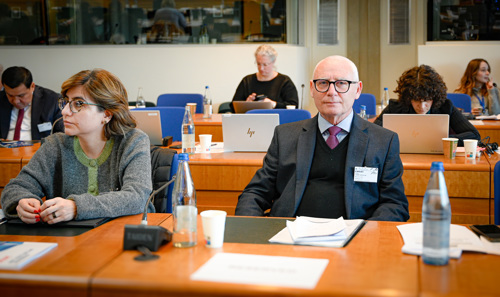
The second day of the Council of Europe High Level Conference with Ombudsperson Institutions and National Human Rights Institutions, known as the Council of Europe ON Forum, was held at the premises of the European Court of Human Rights in Strasbourg.
The two day conference, organised under the auspices of the Moldovan Presidency of the Committee of Ministers, is co organised by the European Court of Human Rights and the Directorate General for Human Rights and Rule of Law within the framework of the Council of Europe’s New Democratic Pact for Europe.
The forum brings together Ombudsperson institutions and National Human Rights Institutions to reflect on their role in protecting democracy and fundamental rights, particularly in addressing challenges such as foreign interference in democratic processes, the erosion of checks and balances, and the protection of freedoms such as expression, opinion and assembly.
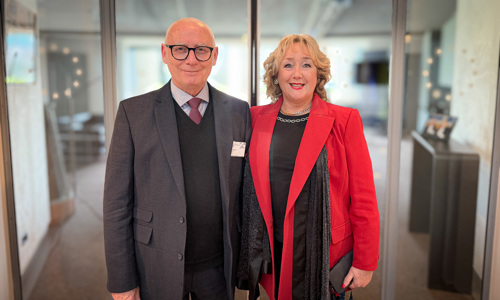
The Parliamentary Ombudsman, Judge Joseph Zammit McKeon and Judge Lorraine Schembri Orland, Judge in respect of Malta to the European Court of Human Rights
The Parliamentary Ombudsman of Malta, Judge Joseph Zammit McKeon, participated in the conference together with representatives of Ombudsman institutions and National Human Rights Institutions from across Europe.
The sessions on the second day focused on the relationship between the European Court of Human Rights and national oversight institutions. Discussions addressed the Court’s case law on freedom of expression, third party interventions before the Court, and the dissemination and execution of the Court’s judgments.
Participants underlined that the case law of the European Court of Human Rights on freedom of expression highlights the important role of Ombudsman institutions and National Human Rights Institutions in promoting awareness of Convention standards and in identifying administrative practices that may unduly restrict the exercise of this fundamental right.
The discussions also addressed the role of Ombudsman institutions and National Human Rights Institutions in third party interventions before the Court. Such interventions enable independent institutions to contribute expertise and human rights perspectives that support the Court in the interpretation and application of the European Convention on Human Rights.
The dissemination of the Court’s case law and the effective execution of its judgments were also highlighted as essential elements of the Convention system. Ombudsman institutions and National Human Rights Institutions contribute significantly in this area by promoting compliance with Convention standards and encouraging national authorities to align administrative practices with the jurisprudence of the Court.
Opening the session, the President of the European Court of Human Rights, Mattias Guyomar, emphasised that the protection of the rule of law cannot rest solely on the shoulders of judges. He underlined the central role played by Ombudsman institutions and National Human Rights Institutions in bridging the gap between national mechanisms and the Court.
The Council of Europe Commissioner for Human Rights, Michael O’Flaherty, described the conference as an important step towards strengthening partnerships between institutions and expressed the hope that such exchanges would become a regular feature. He called for a strong consensus in support of the Convention system and urged participants to seize opportunities to strengthen, rather than weaken, the European human rights framework.
Louise Holck, Chair of the European Network of National Human Rights Institutions and Director of the Danish Institute for Human Rights, noted that the European Court of Human Rights is a key partner for national human rights institutions. She stressed that strong and independent institutions operating in line with the Venice Principles and Council of Europe standards complement the work of the Court. She also emphasised that the execution of the Court’s judgments remains a cornerstone of the Convention system.
Marialena Tsirli, Registrar of the European Court of Human Rights, highlighted that the conference serves as an important outreach initiative with key institutional partners. She noted that such meetings help bring oversight institutions and the Court closer together and provide the Court with valuable insights and comparative perspectives from national institutions.
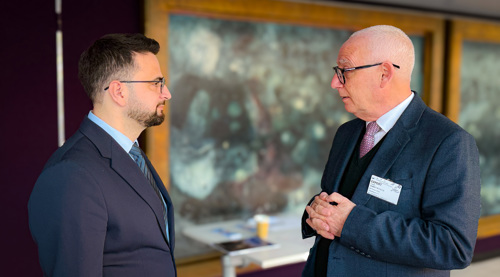
The Parliamentary Ombudsman of Malta with the new Ombudsman of Albania (People's Advocate) and President of the AOM, Endri Shabani
During the discussion on subsidiarity, Judge Joseph Zammit McKeon explained that the European Convention for the Protection of Human Rights and Fundamental Freedoms forms part of Maltese law and is enforceable before a court of constitutional jurisdiction in Malta. The same applies to the Protocols to the Convention that have been signed, ratified and incorporated into Maltese law. However, he noted that although Malta has signed and ratified Protocol No. 12, which introduces a standalone prohibition of discrimination, it has not been incorporated into domestic law. As a result, it is not enforceable before the Maltese courts and may only be invoked before the European Court of Human Rights in Strasbourg.
In her concluding remarks, Judge Diana Kovatcheva of the European Court of Human Rights highlighted that the partnership between the Court, Ombudsman institutions and National Human Rights Institutions is a natural one. She noted that collaboration between these institutions represents an important pillar in the protection of human rights and strengthens the overall system of safeguards established under the Convention.
The discussions reaffirmed the importance of continued cooperation between the European Court of Human Rights, Ombudsman institutions and National Human Rights Institutions in strengthening the protection of human rights and democratic governance across Europe.
